
Imagine a woman in her 60s picking up a pair of light dumbbells. The weights are modest. The movement looks simple. Yet deep inside her muscles, an amazing conversation is beginning. Muscle fibers sense the challenge. Chemical signals switch on. The body starts preparing to become stronger.
Here’s the exciting discovery: your muscles can respond to strength training even as you get older. Scientists have studied this for decades, and the results offer encouraging news for people who want to keep moving, exploring, and enjoying everyday life.
Quick answer: Muscles can adapt to resistance exercise at many ages. Challenging your muscles regularly, eating enough nutritious food, and allowing time for recovery can help support strength and mobility.

The Hidden Work Happening Inside Your Muscles
Every time you get out of a chair, climb a staircase, lift a grocery bag, or swing a tennis racket, thousands of muscle fibers work together.
Inside each muscle fiber are bundles of proteins that slide past one another to produce movement. Two of the main players are called actin and myosin. With the help of ATP, these tiny molecular parts work together to make your muscles contract.
Want to see where that energy comes from? Our guide to mitochondria and ATP explains the remarkable energy-making machines inside your cells.
What Happens When You Lift Something Heavy?
Step 1: Your Muscles Notice the Challenge
When you push against a resistance band, stand up from a chair, or lift a weight, your muscles experience tension. Cells detect that physical challenge through a process scientists call mechanotransduction—a long word for something simple: turning a physical force into a biological message.
Step 2: The Message Reaches the Cell’s Builders
The message activates pathways that help muscle cells adjust and repair. One important pathway involves a protein complex called mTORC1. It helps regulate the building of proteins inside muscle cells.
Think of mTORC1 as part of a construction manager’s team. Exercise supplies the reason to improve the structure. The cell responds by coordinating the work that helps muscle tissue adapt.
Step 3: Protein Supplies Building Materials
Protein from foods such as eggs, fish, yogurt, beans, lentils, tofu, and other nutritious choices is broken down into amino acids. Your body uses these small building blocks to make and repair proteins throughout the body, including muscles.
Some amino acids, especially leucine, also help signal the muscle-building machinery. Scientists are studying how resistance exercise and protein intake work together to support strength in older adults.
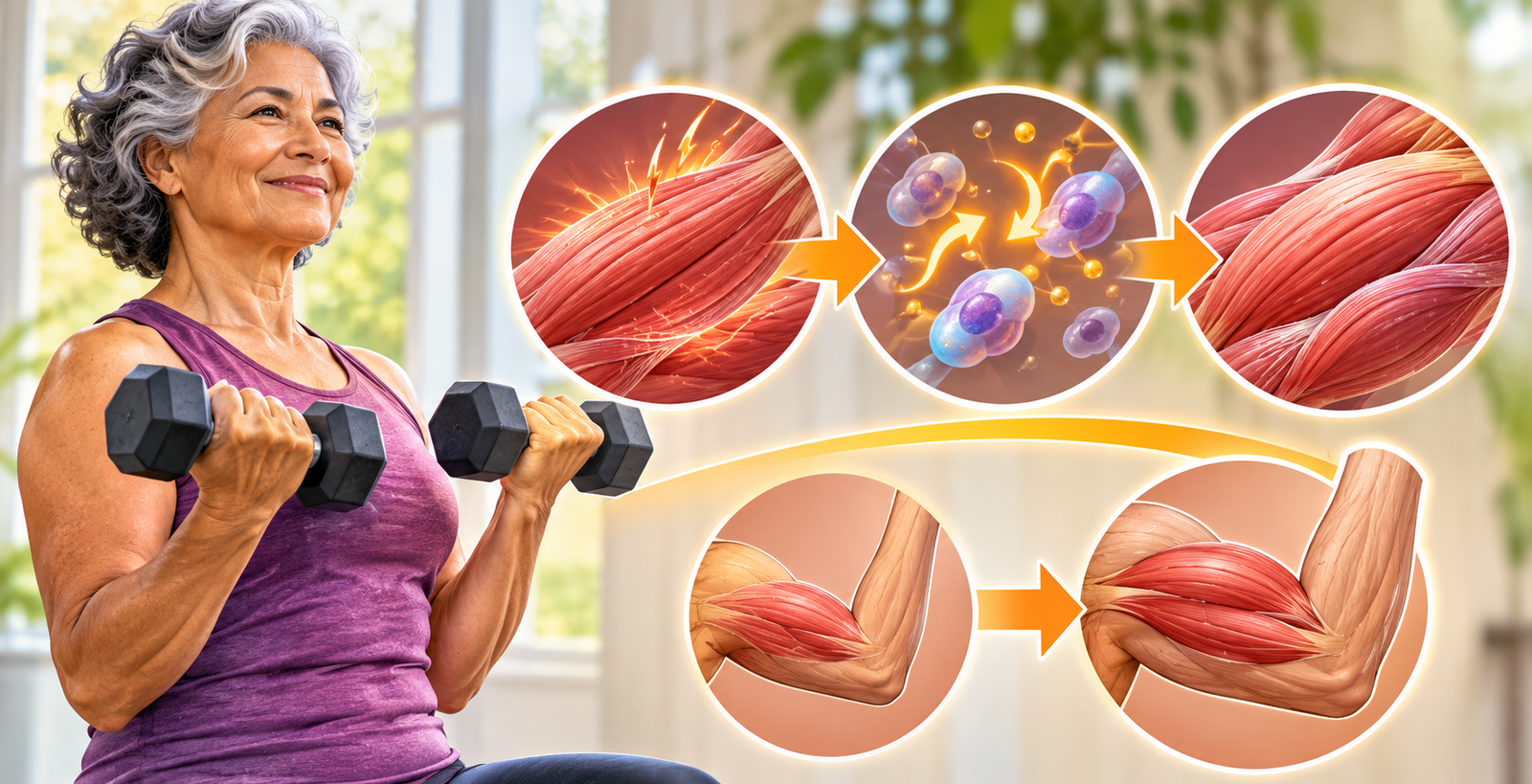
The Surprising Science: Older Muscles Can Still Get Stronger
Researchers supported by the National Institute on Aging have spent decades exploring how strength training helps older adults. They report that resistance exercise can support muscle mass, mobility, and the ability to perform everyday activities.
A 2026 systematic review and meta-analysis combined results from 25 randomized clinical trials involving 1,302 older adults with sarcopenia, a condition involving age-related loss of muscle strength and mass. The researchers found that resistance training improved several measures, including muscle strength, grip strength, walking ability, and lean mass.
That’s the remarkable part: even when muscles have become weaker with age, they can still respond to a well-designed training challenge.
Strength Means More Than Bigger Muscles
Picture carrying a suitcase up a few steps, getting up comfortably from a low chair, or enjoying a long walk on vacation. Strength helps make these moments easier.
Researchers also study muscle power, which is how quickly you can produce force. Getting out of a chair or reacting when you lose your balance requires both strength and the ability to use it at the right moment.
That’s why staying strong is about more than appearance. It’s about maintaining the freedom to do things you enjoy.
How Much Strength Training Helps?
U.S. physical activity guidance recommends activities that strengthen the major muscle groups on at least two days each week. There are many ways to do this, and they don’t all require a gym.
- Resistance bands: Push or pull against stretchy bands.
- Chair stands: Rise from a sturdy chair and sit back down with control.
- Light weights: Practice comfortable, controlled lifting motions.
- Body-weight movements: Adapt exercises to your current ability.
- Everyday activities: Carrying groceries and climbing stairs can challenge muscles, too.
Start with a manageable challenge, then increase the effort gradually as your body adapts. If you have an injury, major balance difficulty, or a medical condition affecting exercise, ask a qualified professional how to adapt the movements safely.

What About Food and Muscle Strength?
Your muscles need both a reason to adapt and the building blocks to do it. Exercise provides the challenge. Nutritious food supplies protein, energy, vitamins, and minerals.
A 2024 review of studies involving older adults with sarcopenia found that combining protein supplementation with resistance exercise improved muscle mass and strength. The researchers studied specific programs and participants, so the results help us understand the combination rather than pointing to one universal meal plan.
For everyday meals, explore our 12 nutrient-rich foods for healthy aging. It’s a practical place to start.
The Amazing Connection Between Muscles and Healthy Aging
Your muscles are living, changing tissue. They respond to movement, food, rest, and the demands of daily life. Each time you challenge them appropriately, you give your body an opportunity to adapt.
Scientists continue to explore the complex signals that connect muscle activity with metabolism and healthy aging. But one lesson is already wonderfully practical: a little resistance training, done consistently, can make a meaningful difference.
Frequently Asked Questions
Can people over 60 build strength?
Yes. Research shows that many adults over 60 improve strength through resistance training, including people starting later in life.
Do I need heavy weights to strengthen muscles?
No. Resistance bands, body-weight movements, and appropriately chosen weights can all challenge muscles. The best starting point depends on your current abilities.
Why do muscles need protein?
Muscles are made largely of proteins. Your body uses amino acids from food to maintain and repair muscle proteins as part of the ongoing process of adaptation.
Is walking enough for muscle strength?
Walking is wonderful for everyday movement and aerobic fitness. Adding activities that challenge the major muscle groups helps build strength more directly.
A Fascinating Final Thought
The next time you stand up from a chair or lift a shopping bag, imagine what’s happening beneath the skin. Tiny protein machines move. Chemical messengers carry instructions. Living muscle fibers respond to the work you ask them to do.
Your muscles have an amazing ability: they can keep learning from movement. That’s a discovery worth putting to work.
Scientific References
- National Institute on Aging. How Can Strength Training Build Healthier Bodies as We Age? (2022).
- Tan Z, et al. Optimizing prescription of resistance training for older adults with sarcopenia: systematic review and meta-analysis (2026).
- Systematic review and meta-analysis of protein supplementation with resistance exercise in older adults with sarcopenia (2024).
- National Institute on Aging. Three Types of Exercise Can Improve Your Health and Physical Ability.
- U.S. Department of Health and Human Services. Stay Active as You Get Older: Quick Tips.
By Healthy Vitality Hub Editorial Team. Educational content based on scientific research and public-health guidance.