
Every second, your heart beats, your brain sends signals, and your muscles stay ready to move. All of that activity needs energy. But how does the energy in the food you eat become something your cells can actually use?
Quick answer: Tiny structures called mitochondria help turn energy from food into a molecule called ATP. ATP is the usable energy supply that powers many of the jobs your cells perform.
Meet Your Cells’ Energy Producers
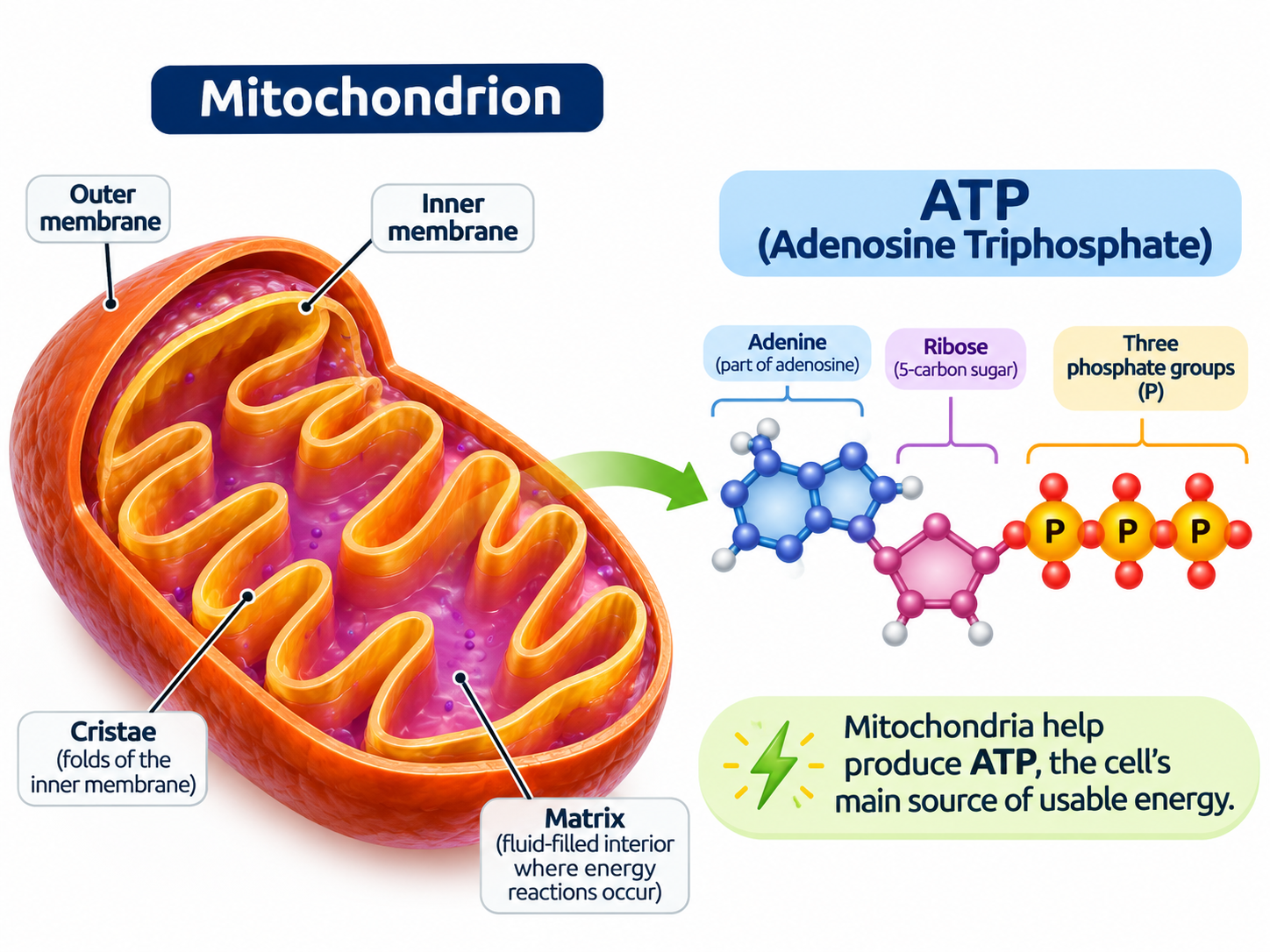
Mitochondria are tiny structures found inside nearly all human cells. Their nickname is the “powerhouses of the cell,” but the science is even more fascinating than that description suggests. According to the National Institutes of Health, mitochondria produce most of the energy cells need. Mitochondria do more than make ATP. For example, they help control calcium levels inside cells, send chemical signals that help cells respond to stress, and take part in the carefully controlled process that removes cells when they are badly damaged or no longer needed. NIH: Mitochondria and Health.
Cells with high energy demands, including muscle cells, often have many mitochondria. They are not all identical, and the number can change as cells adapt to different demands.
What Exactly Is ATP?
ATP stands for adenosine triphosphate. Think of it as a reusable energy-carrying molecule. Your cells can use ATP to power actions such as muscle contraction, nerve signaling, movement of materials, and the building of other molecules.
ATP has three phosphate groups. When enzymes help remove the outer phosphate group, the reaction can release useful energy for cellular work. ATP becomes ADP—adenosine diphosphate—and cells can use energy from metabolism to build ATP again.
The National Institute of General Medical Sciences explains that the body continuously makes and uses ATP, recycling it as life goes on.
How Food and Oxygen Become Usable Energy
Step 1: Food Provides Fuel
Your digestive system breaks down carbohydrates, fats, and proteins. Cells can use products of that breakdown as fuel. Different pathways prepare these fuel molecules for the next stages of energy production.
Step 2: Mitochondria Capture Energy
Inside mitochondria, chemical reactions pass electrons through a series of proteins in the inner membrane. This electron transport chain uses energy from the electrons to move protons—tiny charged particles—across that membrane.
Step 3: An Amazing Molecular Machine Makes ATP
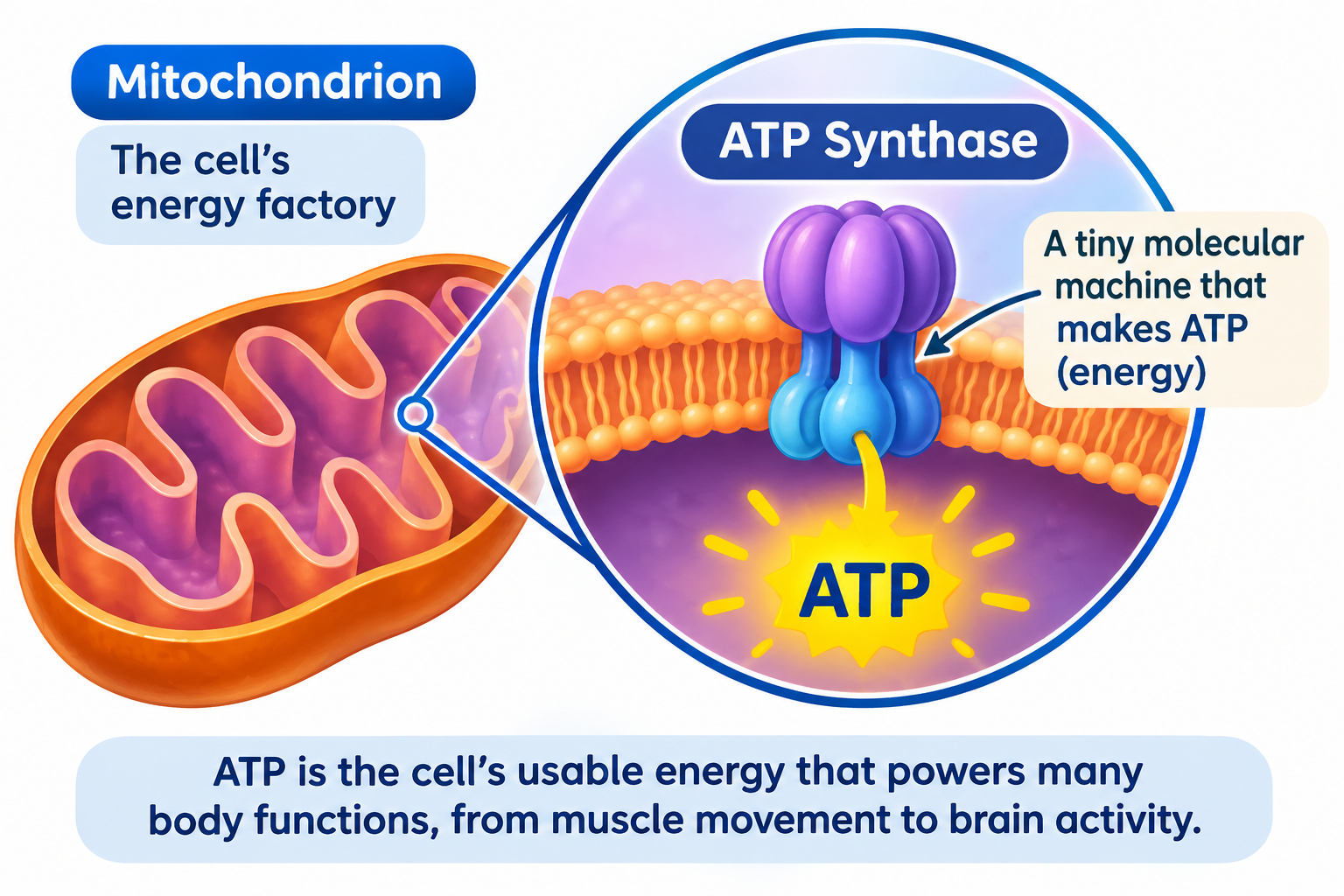
Inside the mitochondrion, tiny charged particles called protons build up on one side of the inner membrane. Then something remarkable happens: they flow back through a molecular machine called ATP synthase, making part of it spin!
That spinning motion helps the machine join ADP with a phosphate group to create ATP—the energy-carrying molecule that powers so many jobs inside your cells.
Scientists call this energy-making process oxidative phosphorylation. It is part of an incredible teamwork system: one set of proteins builds up the protons, and ATP synthase puts their flow to work.
Why Do Muscles and the Brain Need So Much ATP?
Muscle cells need ATP to contract and then relax. Nerve cells need energy to maintain the electrical conditions that let them send signals. ATP also helps cells build and repair important molecules.
That is why mitochondrial energy production matters throughout the body—not just when you exercise. Even while you rest, your cells remain busy.
Mitochondria and Healthy Aging
Researchers are studying how mitochondria change with age and how those changes relate to strength, mobility, and other aspects of health. A 2023 research review involving National Institute on Aging scientists discusses mitochondrial function as a possible factor in age-related mobility changes. These findings open exciting possibilities for understanding how mitochondrial health contributes to healthy aging. Tian and colleagues: Mitochondria and Mobility in Aging.
The most useful everyday takeaway is simple: energy metabolism relies on functioning cells, nutritious food, and the many systems that support physical activity and overall health.
What Supports Everyday Energy Health?
- Eat a varied diet. Your body needs enough overall energy and essential nutrients. Explore our 12 nutrient-rich foods for healthy aging.
- Move regularly. Physical activity challenges muscles and helps the body adapt to energy demands.
- Get enough sleep. Healthy sleep supports many aspects of physical and mental functioning.
- Pay attention to persistent fatigue. Ongoing or unexplained tiredness can have many causes and deserves appropriate medical evaluation.
Frequently Asked Questions
Are mitochondria found in every cell?
They are found in almost all human cells. Mature red blood cells are a notable exception.
Is ATP the same as the food we eat?
No. Food supplies fuel; ATP is a molecule cells make and use to carry energy into specific chemical reactions.
Do mitochondria only produce energy?
No. They also participate in calcium regulation, cellular signaling, and other essential activities.
Why are researchers interested in mitochondrial nutrition?
Scientists are studying how nutrients and specific compounds interact with energy-producing pathways. Research on human outcomes helps us understand which approaches may be most useful.
Final Takeaway
Inside almost every cell, remarkable molecular systems are working to keep you alive. Mitochondria take part in turning the energy from food into ATP, and ATP helps power countless everyday tasks—from thinking to moving. Understanding this process gives us a deeper appreciation for the science of healthy living.
Scientific References
- National Institutes of Health (2025): Mitochondria and Health
- National Institute of General Medical Sciences (2022): ATP’s Amazing Power
- NCBI Bookshelf: The Mitochondrion
- Tian et al. (2023): Energizing Mitochondria to Prevent Mobility Loss in Aging
By Healthy Vitality Hub Editorial Team. Educational information only; not individualized medical advice.
Leave a Reply